
The AI model you are evaluating this month will probably have a successor before your tender process ends.
A pace you can measure
The pace can be measured:
• at equal quality, AI costs 10 times less than a year ago (Epoch AI, 2026);
• every 4 to 7 months, AI agents can carry out tasks twice as long on their own (METR, 2025, updated 2026).
Two costly reflexes
For an SME, this pace pushes towards two costly reflexes.
Laggards wait for the market to "settle down". It will not, and every quarter of waiting widens the gap with competitors who are moving forward.
Pioneers adopt every new release as soon as it comes out, with everything that entails: licences piling up, POCs that stop at the demo, teams switching tools before they have mastered the previous one.
Between the two, the most profitable position is that of the fast followers. They let the pioneers iron out the teething problems, then adopt within a few weeks what has proven its worth.
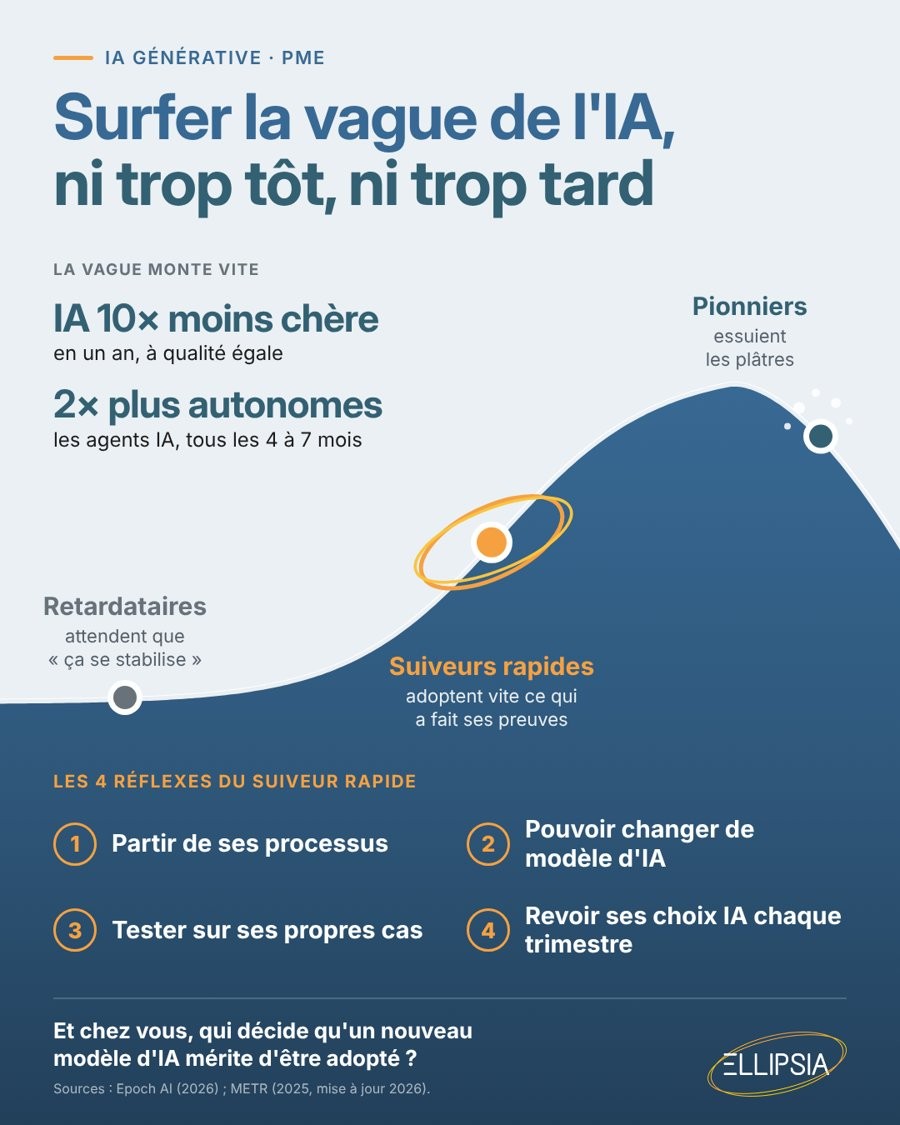
The four reflexes of the fast follower
Four reflexes make it possible to hold this position.
- Start from your processes. The tasks to be improved change little from one year to the next, whereas models change every quarter. Sometimes, a rule or a simple automation does better than an AI.
- Be able to switch AI models. Short commitments, and an architecture where a model can be replaced without rebuilding everything.
- Test on your own cases. Around twenty real situations drawn from your business are enough to evaluate a new model in a few days. Public rankings give a trend; your results decide.
- Review your AI choices every quarter. A short review of ongoing projects, and time-limited tests whose outcome is set at the start: continue, adjust or stop.
At Ellipsia, the first question we ask a senior executive concerns the work to be improved and the level of control expected. The choice of model comes afterwards.
And in your organisation, who decides that a new AI model is worth adopting?
Sources: Epoch AI (2026); METR (2025, updated 2026).