“AI is too expensive.” “It's not worth it.” Business leaders say this more and more often. Most of the time, what was expensive was not the AI: it was the lack of preparatory work.
The “too expensive” diagnosis aims at the wrong target
The figures bear out the disappointed. According to MIT, 95% of generative AI pilot projects produced no measurable financial gain, and the cause lies first in how they were integrated into real work, more than in the quality of the models (report The GenAI Divide, 2025). Gartner, for its part, forecasts that more than 40% of agentic AI projects will be abandoned by the end of 2027, because of runaway costs and poorly established value (June 2025).
Our reading: AI has often been placed on top of work that nobody had looked at closely.
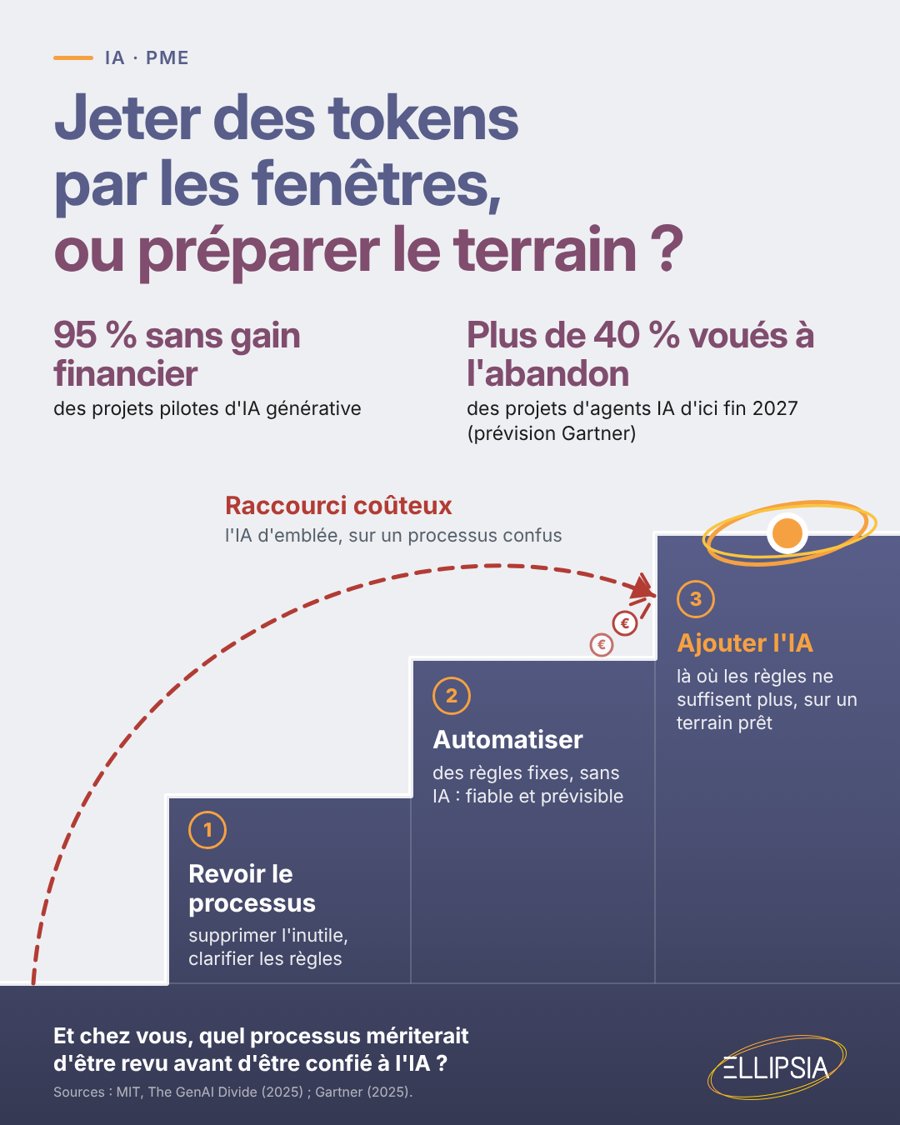
The costly shortcut: throwing tokens out of the window
We used to know how to throw money out of the window. With AI, we have learned to throw tokens out of the window.
The scenario is almost always the same. A slow process, data spread across three tools, rules that only two colleagues know, exceptions that were never written down. A powerful model is dropped in and asked to “take care of it”. The model compensates for this mess on every run: it re-reads, guesses, sometimes gets it wrong, and every pass has to be paid for. Costs climb, errors cause concern, and the project ends up in the “too expensive” column.
Step 1: rethink the process
Remove unnecessary steps, clarify the rules, eliminate double entry. It looks like little, and it is often where the biggest gain lies.
At a multi-site distribution SME, our audit mapped more than eight friction points: double entry, silos between the CRM, the business tools and e-mail. The documented recommendations prioritised sorting and routing incoming e-mails, and showed that the more ambitious projects first depended on the APIs and management tools already in place (DMS, CRM).
Step 2: automate what follows stable rules
A reminder, an invoice reconciliation, a synchronisation between two tools: when the rules are known and the exceptions predictable, conventional automation does the job. It is reliable, explainable, and its cost is predictable. It does not require AI.
Step 3: add AI where rules are no longer enough
Reading a document that follows no template, handling cases that vary, summarising an exchange: this is where AI brings something that rules cannot do.
When you reach this step, the ground is ready. The process is clear, the data is structured, the tools are connected. AI fits in more easily, its autonomy can stay bounded where an error is costly, and you can measure what it brings.
At Ellipsia, we start from the process before talking about tools, and “you don't need AI here” is a conclusion we stand by.
And in your organisation, which process deserves to be reviewed before being handed to AI?
Sources
- MIT, The GenAI Divide: State of AI in Business 2025, as presented by Computing: https://computing.co.uk/news/2025/ai/mit-report-95pc-corporate-generative-ai-pilots-fail
- Gartner, press release of 25 June 2025: https://www.gartner.com/en/newsroom/press-releases/2025-06-25-gartner-predicts-over-40-percent-of-agentic-ai-projects-will-be-canceled-by-end-of-2027